Every year, thousands of Indian students who clear NEET but can't secure a government seat face the same crossroads. Private colleges charge upwards of ₹80–90 lakhs. That's where studying MBBS in Russia becomes a genuinely compelling option — not just a backup plan. Russia has one of the oldest and most established medical education systems in the world, with universities dating back over 200 years. The degree is recognized by the National Medical Commission (NMC) of India, the World Health Organization (WHO), and medical councils across 45+ countries. If you're exploring MBBS abroad, Russia deserves a serious look — and this guide gives you everything you need to make that decision wisely.
Quick Facts: MBBS in Russia at a Glance
Parameter
Details
Course Duration
6 years (including 1-year internship)
Medium of Instruction
English (most universities offer English-medium programs)
Total Fees (Approx.)
₹20 – ₹40 lakhs (entire course)
Annual Tuition Fees
₹2.5 – ₹5 lakhs per year
Living Cost Per Month
₹10,000 – ₹18,000 (hostel + food)
NEET Required?
Yes (mandatory as per NMC guidelines)
NMC Recognition
Yes (select universities)
WHO Listed
Yes
Entrance Test in Russia
No (admission based on NEET score + academics)
Visa Type
Student Visa (Type D)
Intake Season
September – October (main) | February (some universities)
Indian Students Currently Enrolled
Approx. 15,000–17,000+
Why Russia? The Real Reasons Indian Students Choose It
Let's be direct — Russia isn't just "affordable." That word gets thrown around loosely. The real picture is more nuanced. Here's what actually makes Russian medical universities work for Indian students:
1. The Cost Gap vs. India Is Enormous
A government MBBS seat in India costs roughly ₹3–6 lakhs total. But with only 1.10 lakh government seats and over 20 lakh NEET candidates in 2024, the math doesn't work for most students. Private colleges fill this gap — but at ₹80 to ₹1.2 crore in total fees. Russia's top medical universities charge ₹20–40 lakhs for the full 6-year program. That's a ₹50–80 lakh difference. For many middle-class families, this isn't just "affordable" — it's life-changing.
2. No Donation. No Capitation Fee.
This is huge. Russian universities don't have a "management quota" system where seats are auctioned. Admission is merit and document-based. What you pay is what's published — no hidden amounts, no under-the-table payments.
3. The Universities Are Old. Very Old.
Kazan Federal University was founded in 1804. Pirogov Russian National Research Medical University in Moscow has been training doctors since 1906. These aren't fly-by-night institutions. The faculty depth, clinical exposure, and research infrastructure are serious.
4. NMC Recognition Means You Can Return and Practice
Post-2021 NMC guidelines require Indian students to attend NMC-listed foreign universities. Russia has 50+ universities on that list. Graduating from a recognized Russian university and clearing the NExT exam allows you to register and practice in India.
5. Climate, Community, and Indian Food
This sounds minor, but it matters. Cities like Kazan, Volgograd, and Kursk have well-established Indian student communities. Most universities have Indian mess facilities. Winters are harsh, yes — but students adapt, and the experience of living abroad builds a kind of independence that's hard to find otherwise.
Top NMC-Approved Universities for MBBS in Russia
Kazan State Medical University
One of the oldest government medical universities in Russia, recognized by NMC and WHO. Known for strong clinical exposure and a good track record for FMGE/NExT preparation.
Kazan Federal University
A top-ranked federal university offering modern MBBS programs with advanced research infrastructure and global collaborations.
Volgograd State Medical University
Popular among Indian students for its English-medium MBBS program and solid FMGE performance history.
Tver State Medical University
An affordable government medical university providing English-medium education and early clinical exposure.
MEPhI Moscow (National Research Nuclear University)
A leading institute in nuclear science, AI, and engineering, globally recognized for STEM research (non-medical focus).
MEPhI Obninsk
Specialized campus focused on nuclear power engineering, offering strong practical exposure in energy technologies.
Lobachevsky State University
Renowned for research in mathematics, physics, and IT, with growing medical and scientific programs.
Novosibirsk State University
Located in a major research hub, known for innovation, science, and high-quality education in medicine and technology.
North-Western State Medical University
Based in St. Petersburg, offering strong clinical training and globally recognized medical degrees.
First Moscow State Medical University (Sechenov University)
Russia’s top medical university with advanced research facilities and high global ranking.
Kursk State Medical University
One of the first to offer English-medium MBBS, popular among Indian students with strong academic balance.
Synergy University
A private university focused on business, management, and digital skills with industry-oriented programs.
MBBS in Russia Fee Structure: Detailed Breakdown
Expense Category
Annual Cost (Approx. INR)
6-Year Total (Approx. INR)
Tuition Fees
₹2.5 – ₹5 lakhs
₹15 – ₹30 lakhs
Hostel / Accommodation
₹60,000 – ₹1 lakh
₹3.6 – ₹6 lakhs
Food & Groceries
₹60,000 – ₹90,000
₹3.6 – ₹5.4 lakhs
Health Insurance
₹10,000 – ₹15,000
₹60,000 – ₹90,000
Books & Study Material
₹15,000 – ₹25,000
₹90,000 – ₹1.5 lakhs
Personal Expenses / Travel
₹30,000 – ₹60,000
₹1.8 – ₹3.6 lakhs
Total Estimated Cost
₹4 – ₹8.5 lakhs/year
₹24 – ₹47 lakhs (6 years)
Note: Fees vary by university and are subject to exchange rate fluctuations (Russian Ruble vs. INR). Always confirm fee structures directly with the university or a verified admission consultant before paying anything.
Eligibility Criteria for MBBS in Russia
The eligibility requirements are relatively straightforward, but every point matters. Missing even one criterion can lead to rejection at the Indian port of departure or by the university.
NEET Score: A valid NEET-UG score is mandatory as per NMC guidelines (2021 onward). There is no minimum cutoff specified for Russia, but most universities expect NEET qualifiers. The higher your score, the better the university you can target.
Age: Minimum 17 years as of December 31 of the admission year.
Academic Qualification: 10+2 from a recognized board with Physics, Chemistry, and Biology (PCB). Minimum 50% aggregate in PCB for general category. SC/ST/OBC: 40% (as per NMC norms).
English Proficiency: No IELTS/TOEFL required for most Russian universities. Basic English communication ability is expected since lectures are in English.
Medical Fitness: A medical fitness certificate may be required at the time of visa application.
Admission Process: Step-by-Step
The admission process for MBBS in Russia is direct — but there are specific steps that, if missed or done out of order, create real problems. Many students come back with issues simply because they didn't follow the right sequence. Here's the proper flow:
Step 1: Clear NEET and Obtain Scorecard
This is non-negotiable. Without a NEET scorecard, you cannot legally enroll in a medical program abroad under NMC rules. Download your scorecard from the NTA portal and keep multiple copies.
Step 2: Research and Shortlist Universities
Cross-check the NMC's official Foreign Medical Graduate list. Don't just go by what an agent tells you — verify independently. Shortlist 2–3 universities based on fees, location, clinical infrastructure, and Indian student presence.
Step 3: Apply to the University
Submit your application directly to the university or through an authorized representative. Documents typically submitted at this stage: 10th and 12th marksheets, NEET scorecard, passport copy, and photographs. Most universities respond with an invitation letter within 2–4 weeks.
Step 4: Receive Official Invitation Letter
This is your primary document for the Russian student visa. The letter must be issued by the university and verified by the Russian Ministry of Education. Do not proceed with the visa without this letter.
Step 5: Apply for Russian Student Visa (Type D)
Submit the visa application at the nearest Russian Embassy or Consulate in India (New Delhi, Mumbai, Chennai, Kolkata). Processing time: 10–30 working days. Required documents include the invitation letter, passport, application form, photos, and health certificate.
Step 6: Travel and University Registration
Once in Russia, complete on-campus registration, submit originals, and get your student ID. You'll also need to register with local migration authorities within 3 working days of arrival — the university typically handles this for international students.
Step 7: Begin Academic Year
Classes generally start in September. The first year covers pre-clinical subjects. Russian language is taught in Year 1 as a subject — important for clinical interactions later.
Documents Required
Valid passport (minimum 18 months validity from date of travel)
NEET scorecard and admit card
10th mark sheet and passing certificate
12th mark sheet and passing certificate
School Transfer Certificate / Migration Certificate
Birth certificate
6–8 passport-size photographs (white background)
Medical fitness certificate (from a registered doctor)
HIV test report (some universities require this)
University invitation letter (original)
Police Clearance Certificate (PCC) — may be required
All documents must be attested/apostilled. For degree certificates, attestation from the State Education Board + MEA (Ministry of External Affairs) is required. Start this process early — it can take 3–6 weeks.
Career After MBBS in Russia: NExT, FMGE, and Beyond
This is the question students ask most — and rightfully so. Completing MBBS from Russia is just the beginning. To practice in India, you need to clear the NExT examination (National Exit Test), which has replaced the older FMGE (Foreign Medical Graduates Examination) under NMC's revised framework.
What Is NExT?
NExT is a two-step licensing exam introduced by NMC. Step 1 (theory) and Step 2 (clinical/practical) together serve as both the final-year university exam and the Indian licensing exam. Students who pass NExT can get registered with the NMC and practice medicine in India.
What Was the FMGE Pass Rate?
Historically, the FMGE pass rate for Russia-returned students has been around 35–45%. This sounds low — and it is a real challenge. However, students who invest in dedicated NExT/FMGE preparation during their final 1–2 years in Russia significantly improve their odds. Several coaching programs in Russia and India are specifically designed for this.
Other Career Paths After MBBS in Russia
Pursue postgraduate medical studies (MD/MS) in India after clearing NExT
Apply for residency or licensing in UAE, Germany, UK (requires additional exams like PLAB, USMLE)
Practice in countries where the Russian degree is directly recognized (several CIS countries)
Enter research, public health, or hospital administration roles
Important Tips Before You Apply
Always verify NMC recognition on the official NMC website before paying any fees. University lists are updated — what was recognized last year may have conditions this year.
Avoid unregistered agents. Several fraudulent operators promise guaranteed admissions, collect large sums, and disappear. Work with registered consultants or apply directly.
Learn basic Russian. Even if your MBBS is in English, clinical rotations involve Russian patients. Universities teach Russian, but taking it seriously from Year 1 makes clinical years far smoother.
Understand the exchange rate risk. Fees are usually quoted in USD or rubles. INR–Ruble exchange rates can fluctuate. Budget with a buffer of 10–15%.
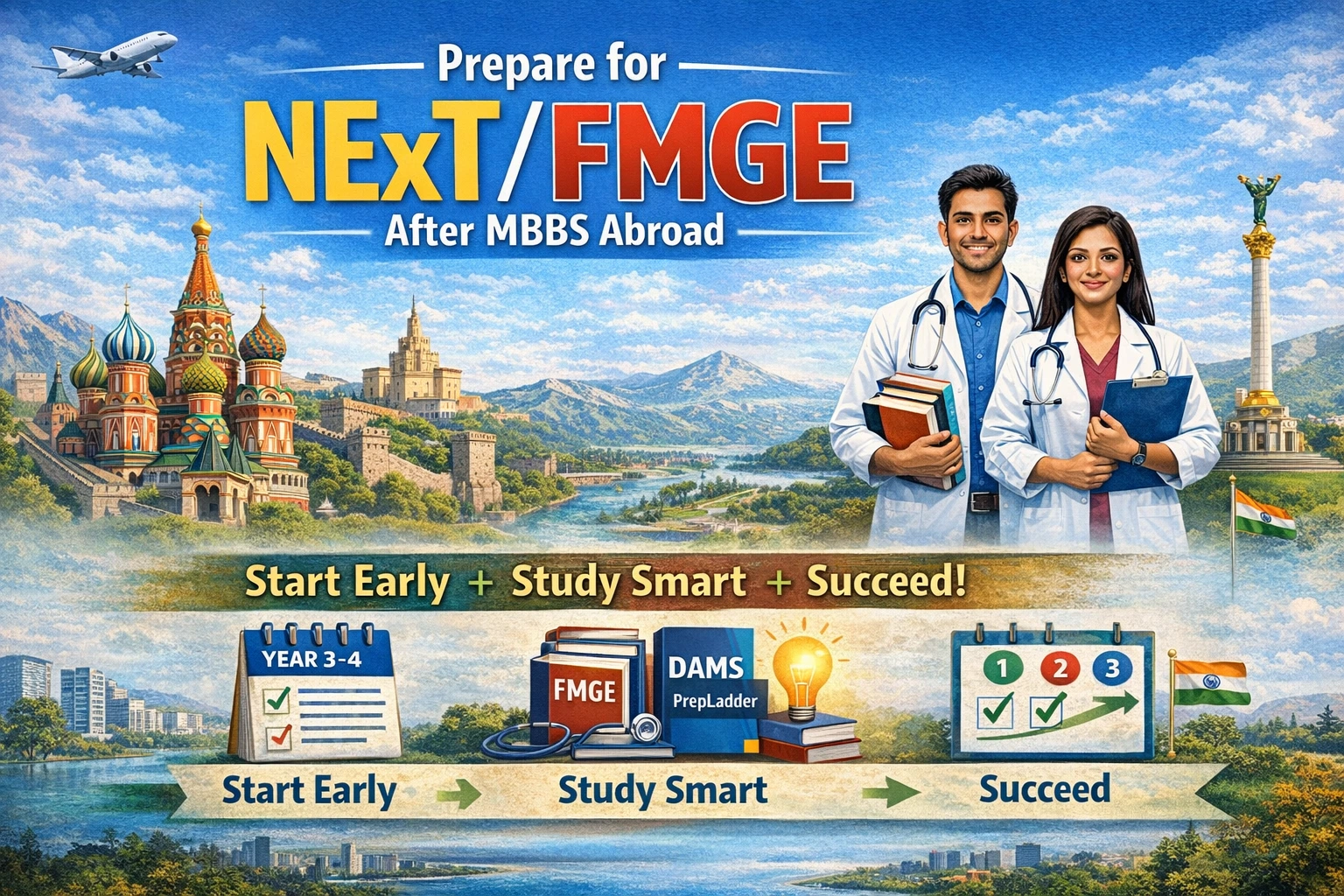
Start NExT/FMGE prep early. Students who start preparation from Year 3 or 4 — not Year 6 — perform dramatically better on the licensing exam.
Yes. As per NMC's 2021 regulations, any Indian student pursuing MBBS abroad must have a valid NEET-UG score. Without clearing NEET, you cannot obtain an eligibility certificate, which is required for enrollment and eventually for the NExT exam.
2. How many years is the MBBS course in Russia?
The MBBS program in Russia is 6 years — 5 years of academic study followed by a 1-year internship. Some universities integrate the internship differently, so check the specific program structure at your chosen university.
3. What is the total cost of MBBS in Russia for Indian students?
All-inclusive (tuition + accommodation + food + miscellaneous), you're looking at roughly ₹25 – ₹47 lakhs for the full 6 years depending on the university and city. This is significantly lower than Indian private medical colleges that charge ₹80–120 lakhs.
4. Do Russian medical universities teach in English?
Most top universities offer dedicated English-medium programs for international students. Russian language is taught as a subject in Year 1 and is practically necessary for clinical rotations where patients speak Russian.
5. Can I practice medicine in India after MBBS from Russia?
Yes — provided you graduate from an NMC-recognized Russian university and clear the NExT examination. Clearing NExT gives you NMC registration and the right to practice in India.
6. How long does the Russian student visa take?
Typically 10–30 working days from the date of application submission. You need the official invitation letter from the Russian university before applying. Start the visa process at least 6–8 weeks before your intended departure date.
7. What is the NExT / FMGE pass rate for students returning from Russia?
Historically, around 35–50% of Russia-returned students clear FMGE in the first attempt. The pass rate varies significantly based on preparation. Students who use structured coaching programs and begin prep from Year 3 or 4 tend to perform significantly better than those who start only in Year 6.
8. Is it safe for Indian students to live in Russia?
Generally, yes. Cities like Kazan, Kursk, Volgograd, and Rostov-on-Don have established Indian student communities and are considered safe for international students. Staying in university-recommended hostels and maintaining contact with your student association is always advisable. Check current travel advisories from the Indian Embassy before departure.
Scholarship Opportunity for MBBS in Russia
Gauranga Consultancy is offering limited scholarship support for eligible Indian students applying for MBBS in Russia (2025 intake). Get assistance with university selection, admission process, visa guidance, and fee optimization.
Thinking about applying? The admission window for September 2026 intake opens around May–July. Documents take time — especially attestation and police verification. Students who start the process early, ideally 3–4 months before the intake, tend to have a smoother experience. If you're unsure which university suits your NEET score and budget, a consultation with a verified education advisor can help you avoid the most common and costly mistakes.
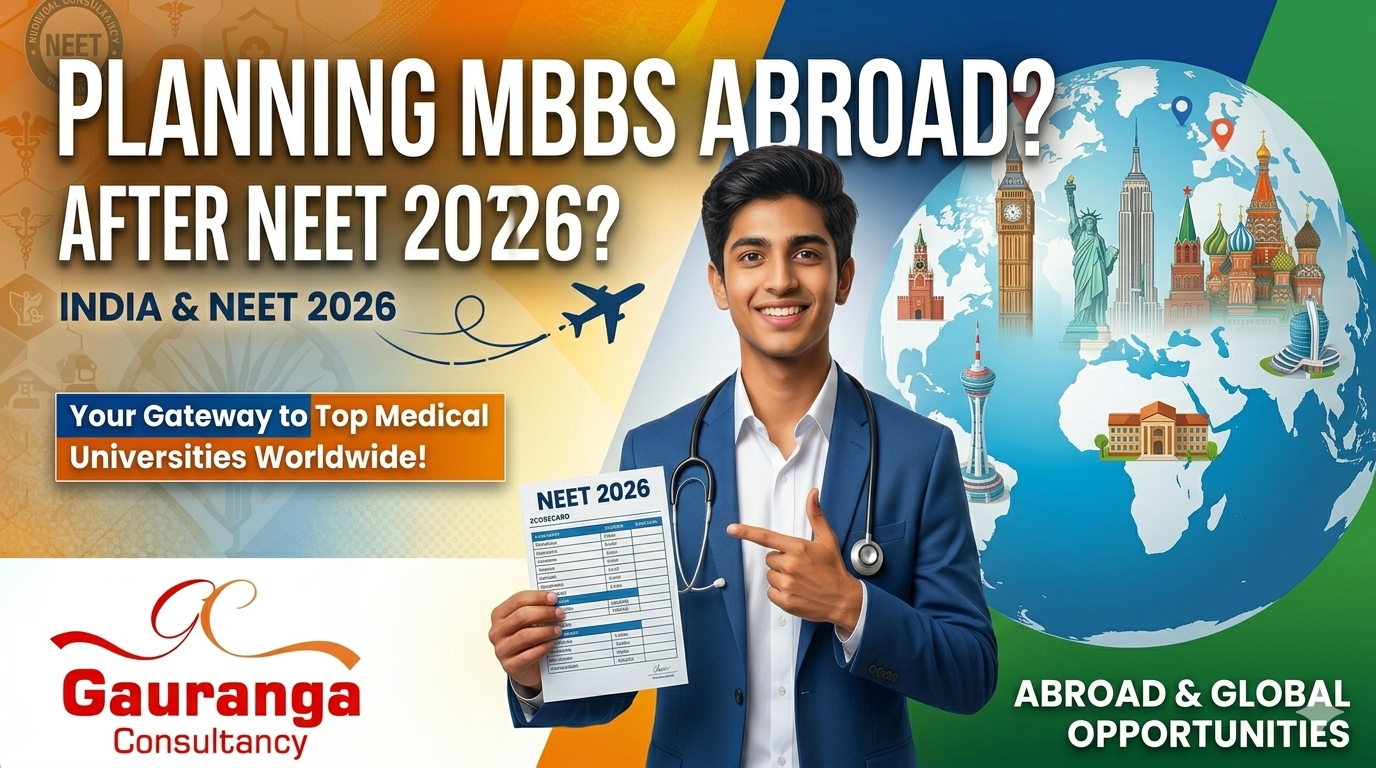
Thinking about MBBS abroad after NEET 2026? Learn about top countries, NMC-approved universities, fees, and the admission process for Indian students....
You've spent 6 years getting your MBBS degree abroad. The hard part should be over — except it isn't. For Indian students returning from Russia, Ukraine, China, Georgia, or any other country, the NE...
Choosing the right medical university abroad is a vital decision for future doctors. With the increasing popularity of MBBS studies overseas, it’s important to select a university that is both globa...